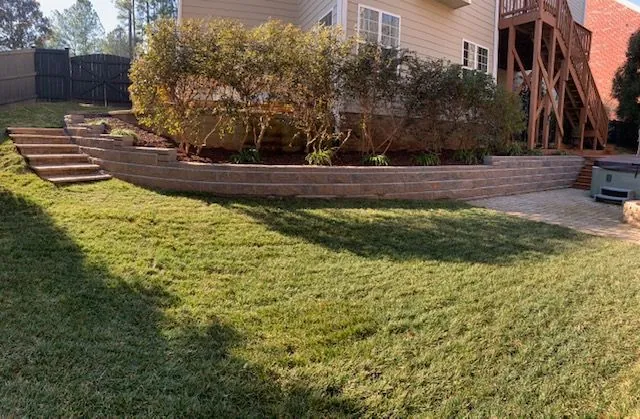
Can a failing retaining wall in Roswell be repaired?
Many can. Loose caps, a few displaced blocks, a washed-out toe, or a clogged drain outlet are repairs. A wall that leans, bulges, or sinks along a stretch is usually failing from water pressure or a weak base, and that section has to be taken down and rebuilt with proper drainage.
The difference matters for your budget. A repair is a day or two of work. A rebuild is a new wall, with a base, drainage, and sometimes a permit and an engineer. We tell you which one you are looking at, and why, before we price anything.
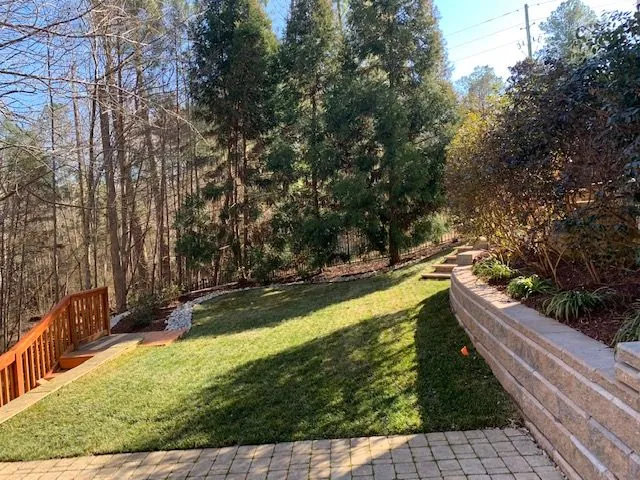
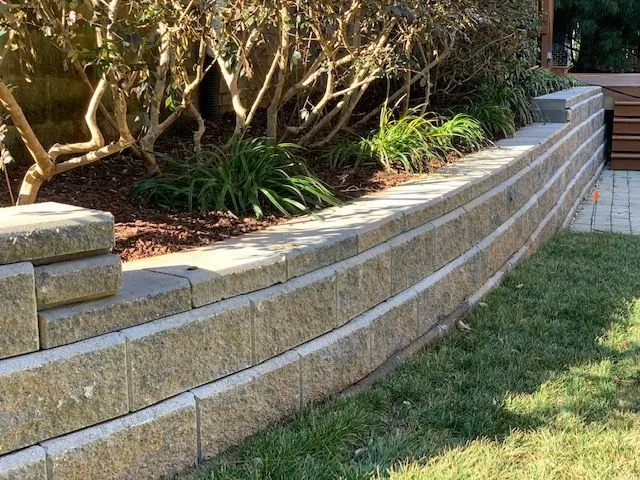
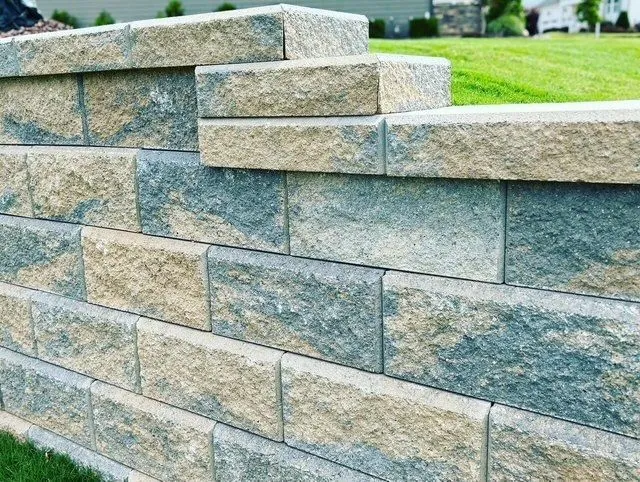
What is your wall telling you?
Pick what you can see from the yard. The reading points you toward a repair, a rebuild, or a drainage fix, and to the page that explains it.
Tool: what is my wall telling me?Field check
What do you see? Pick all that apply.
Pick what you see on your wall.
A reading, not an inspection. Anything that is moving fast, or sits under a driveway or house, should be looked at in person.
Leaning toward a driveway, a house, or a public sidewalk? Keep cars and heavy loads off the high side and call us before the next big rain.
Why do so many walls fail in Roswell?
Water does most of the damage. Rain soaks the clay behind the wall, the clay gets heavy, and with nowhere to drain the pressure keeps building until the wall moves. Roswell's red clay subsoil holds water longer than sandy ground, so a wall here needs a clear path for it.
- No drainage stone. Walls backfilled with the same clay that was dug out trap water right against the block.
- No outlet. A drain pipe that ends in the ground behind the wall collects water and then holds it.
- Shallow base. When the first course sits on the surface instead of a compacted stone base below grade, the wall can slide or settle.
- Too tall for the build. Taller walls need geogrid tied back into the slope. Without it, the top of the wall rotates outward.
- Load above. A driveway, a pool, or a house close to the top adds weight the original wall may not have been designed for.
- Roots and runoff. Tree roots lift caps and push courses, and a downspout aimed at the top of a wall washes out its backfill.
For background on why Piedmont clay holds water, see the New Georgia Encyclopedia on Georgia soils. The wall drainage page shows what should be behind a wall and how we add it to an existing one.
When is it a repair, and when is it a rebuild?
| Usually a repair | Caps loose or missing, a few top blocks pushed off, a short washed-out toe, a crushed or buried pipe outlet, a small area of soil coming through joints. |
|---|---|
| Usually a rebuild | A lean along a stretch, a bulge in the middle courses, one end sinking, stepped cracks that keep widening in a poured or mortared wall, rotted wood. |
| Look in person soon | Any movement under a driveway, a house, a pool deck, or a neighbor's property, and any wall over 4 feet that is moving. |
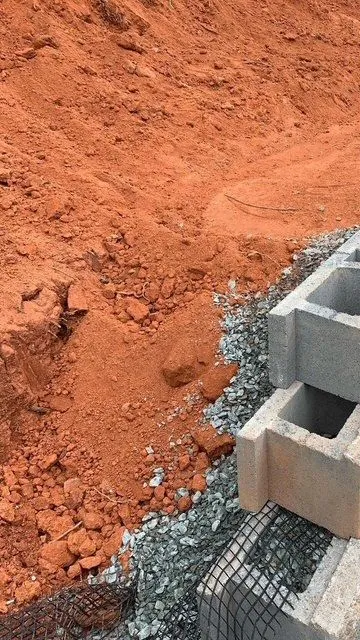
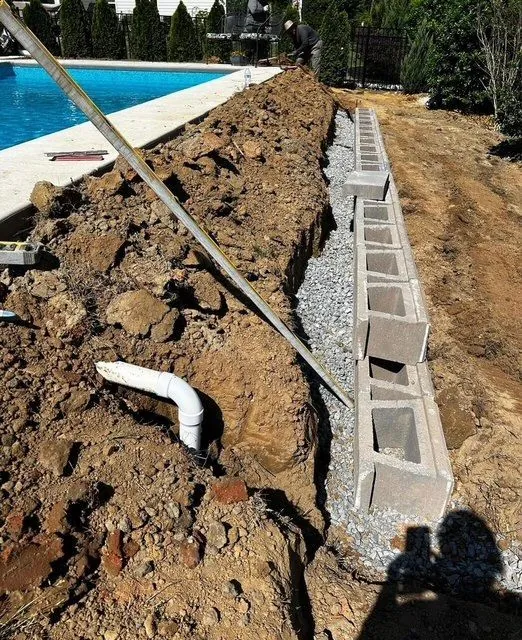
For a rebuild we take the wall down to sound courses or to the base, cut back the clay, and rebuild with a compacted base, drainage stone, fabric, pipe to daylight, and geogrid where the design calls for it. Old block that is still sound can often go back in, which keeps the look and the cost down.
What does Roswell require when a wall is rebuilt?
A rebuild is treated as building a wall. The City of Roswell's combined residential building and land disturbance application lists retaining walls as a permit type. Its checklist says walls greater than 4 feet, measured from the bottom of the foundation to the top of the wall, must be designed by a qualified engineer, with the engineer's wall design certification and a property owner indemnification submitted with the application.
The city also asks for wall detail sheets with a section, an elevation and foundation details, design calculations where they apply, and a site plan showing erosion control. Walls near a stream or the Chattahoochee can run into buffer limits too. The Roswell permit page covers both.
What happens at a repair visit?
Look and photograph
We measure the lean, check the toe and outlets, and open a small section if we need to see the base and backfill.
Explain the cause
You get a plain answer on why the wall is moving and whether it is a repair, a partial rebuild, or a full rebuild.
Free estimate
We price the work with the steps listed, including haul-off, drainage, and any permit or engineer.
Fix the water first
Drainage goes in as the wall goes back up, so the same failure does not repeat.
Walk it with you
We show you the outlet, explain what to watch, and leave the yard clean.