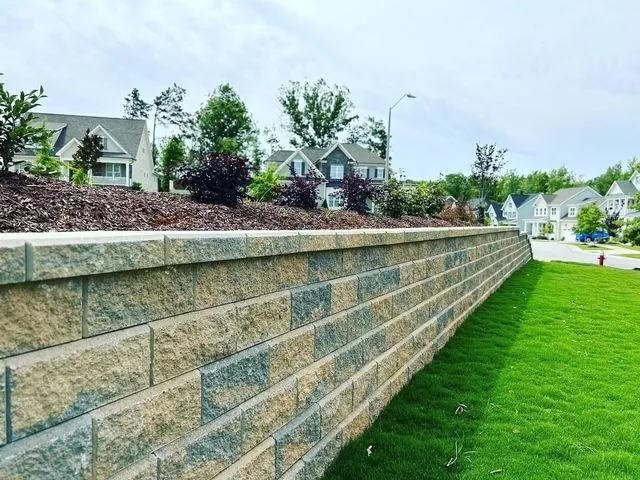
What makes a retaining wall job in Johns Creek different?
Water and low thresholds. Johns Creek keeps a 50-foot undisturbed buffer around every stream, creek, lake, pond and spring, adds a 25-foot setback where hard surfaces are not allowed, and requires a Land Disturbance Permit once a job disturbs 1,000 square feet of ground.
Those three numbers, from the city's Land Development page, decide more about a wall here than the block or stone you pick. A wall often belongs exactly where the yard drops toward water, which is where the rules are tightest. So on a Johns Creek lot we find the water first, mark the buffer and setback, and then decide where the wall can live and how big the dig will be.
The 1,000 square foot line is worth knowing about early. For comparison, Roswell's general land disturbance threshold is 5,000 square feet. Here the work strip for a mid-sized wall, counting the excavation, the drainage stone and the backfill zone behind the block, can reach it before the wall itself looks large.
Where can the wall go on a lot near water?
Slide the distance to the edge of the creek or pond and enter a rough wall size. The tool reads the city's buffer, setback and land disturbance numbers against it.
Tool: Johns Creek lot checkBuffer and LDP
Set the distance and the wall size.
The work strip is a planning assumption, not a measured area. Buffers are measured from the water's edge as the city defines it, so we confirm the line on site.
If the reading lands inside the buffer, that is not the end of the project. It usually means the wall moves upslope and the grade between the wall and the water is handled with planting instead of block. The drainage page explains how we route a wall's pipe outlet so it does not dump water across a buffer.
When does a Johns Creek retaining wall need a building permit?
At 48 inches or higher. The city's "Do I need a permit?" list puts retaining walls 48 inches or higher in the permit column, and the site plan for that permit has to show the wall's elevations and come with a boundary survey.
City of Johns Creek: retaining walls and land disturbance
| Building permit | Retaining walls 48 inches or higher |
|---|---|
| Site plan | Top-of-wall and bottom-of-wall elevations at several points along the length of the wall |
| Survey | A site (boundary) survey is required for retaining walls |
| Stream buffer | 50-foot undisturbed buffer on streams, creeks, lakes, ponds, springs and other natural waters, plus a 25-foot setback with no impervious surfaces |
| Land disturbance | Land Disturbance Permit at 1,000 square feet or more; a minor LDP may be required below that, case by case |
| Office | Community Development, 11360 Lakefield Drive, Johns Creek, GA 30097. 678-512-3250 |
Source: Do I need a permit?, site plan requirements and Land Development, City of Johns Creek
The elevation requirement is the part homeowners rarely expect. The city wants the top and bottom of the wall shown at several points along its length, which is a fair picture of how the wall really steps with the ground. We shoot those elevations when we lay the wall out, so the drawing matches what gets built. If you are unsure whether your project needs a permit, the city invites calls to 678-512-3250.
What is the ground like along the river side of Johns Creek?
It falls toward the Chattahoochee. Johns Creek is bounded on the south by the river, with 13.5 miles of riverfront, and its elevation runs from about 880 feet along the river up to roughly 1,180 feet in the Ocee area near Alpharetta.
Three hundred feet of fall across a city means yards that slope one way or another, with water heading for the river. The city's own name comes from one of them: a local tributary named after Johnson K. Rogers gave the area its name. Wooded tracts like the 46 acres at Autrey Mill Nature Preserve and open ground like Newtown Park sit among the neighborhoods. Where a backyard ends at a drainage or a creek, the buffer rules above apply before anything else.
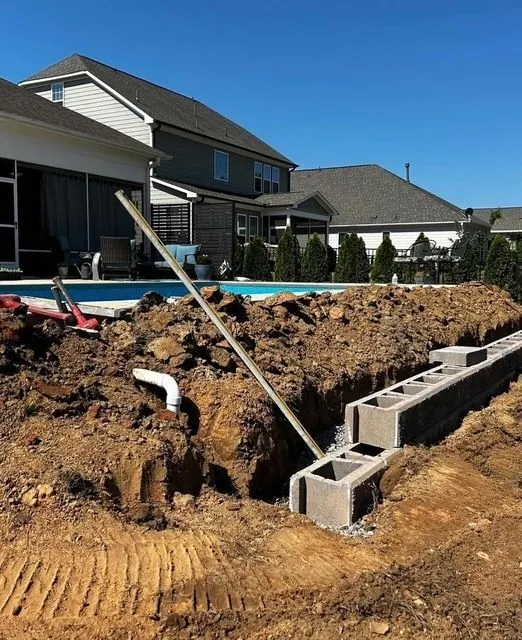
For a wall, that slope and water pattern means two things. The base has to sit on firm, compacted stone below the topsoil, and the water behind the wall needs a planned exit that does not run straight across a neighbor's lot or into a buffer. We design both before we price.
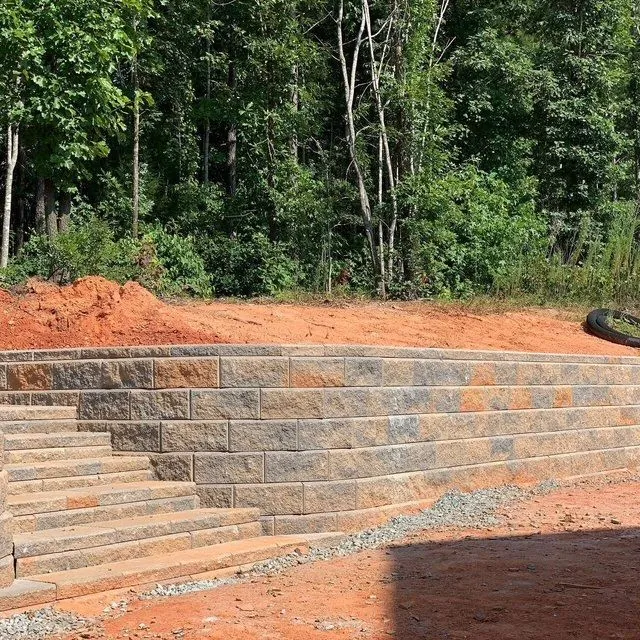
Which kind of wall makes sense on a Johns Creek lot?
The one that fits the space you have outside the buffer. On tight ground near water, a segmental block wall with geogrid often gives the most usable yard for the least footprint; on open ground, natural stone or a terraced pair may suit the look you want.
- Replacing timber. Railroad tie and timber walls rot from the inside, and the soft wood rarely shows how bad it is until the wall leans. Crosstie wall replacement covers removal and the rebuild.
- Stone near the house. Stacked and stone-faced walls suit front beds and patios where the wall is seen up close. See natural stone walls.
- Tall block in back. Where the yard drops several feet, block with drainage stone and grid is the workhorse. Over 48 inches it goes through the city's permit and elevation drawing.
No Johns Creek project list or reviews are shown here. We will show you finished walls in person at the estimate.
How far is Johns Creek from our shop?
It is next door. Roswell borders Johns Creek on the west, and our office is at 875 Atlanta St in Roswell, so Johns Creek addresses are a short drive for the crew.
Neighboring cities write their rules differently, which is why we keep a page for each. If your parcel turns out to sit across a line, the estimate follows that city's rules instead.
- AlpharettaSite walls over 4 feet, or any height under a driveway, need a permit
- Sandy SpringsAcross the river from Roswell, with finish and setback rules by zoning district
- RoswellOur base, with a 4-foot engineer line measured from the bottom of the foundation