Our story
A Roswell retaining wall company, established in 2019 around the half of a wall nobody sees.
Why did a retaining wall company start in Roswell in 2019?
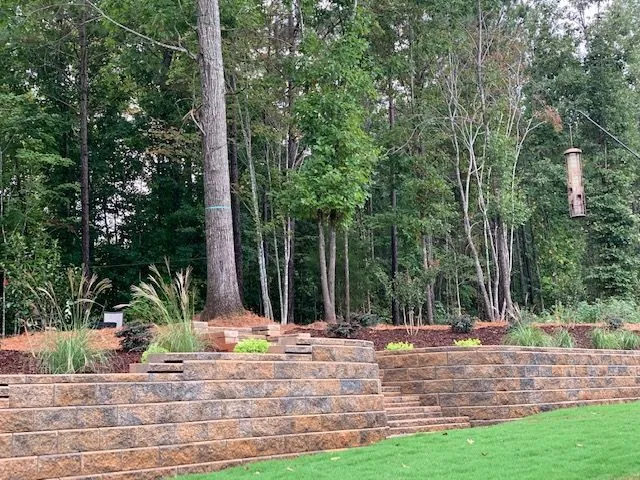
Landmark Roswell Retaining Wall Contractors was established in 2019 because the same call kept coming in: a wall in a Roswell backyard was leaning, bulging, or spilling clay onto the lawn, and the homeowner wanted to know whether it could be saved. There were plenty of crews willing to stack block. There were far fewer willing to explain why the last wall failed.
Roswell made sense as home base. The city runs along the Chattahoochee, its creeks cut through older neighborhoods and newer subdivisions alike, and many lots were graded into terraces that only hold because a wall holds them. A company that wanted to do nothing but walls had steady, honest work here.
What did the founders see on failed walls?
Before the company had a name, its founders spent a lot of time taking apart walls that had given up. The pattern repeated almost every time:
- Clay against the block. The soil dug out of the slope went straight back behind the wall, so rain had nowhere to go but against it.
- A pipe to nowhere. Some walls had a drain pipe, but it ended in the ground behind the wall instead of running to daylight.
- A first course on the surface. No compacted stone base, so the wall settled and slid.
- Height nobody measured. Walls built taller than the city's engineer line with no design and no geogrid.
- Rotted wood. Railroad tie walls from decades ago, soft to a screwdriver and leaning into driveways.
Every one of those walls had looked fine on its last day of construction. The problems were buried, and it took a few wet seasons on Roswell clay for them to surface. That lesson became the whole business model.
How did our approach to drainage, engineering and permits take shape?
Out of those tear-outs came three rules we still work by:
Drainage comes first
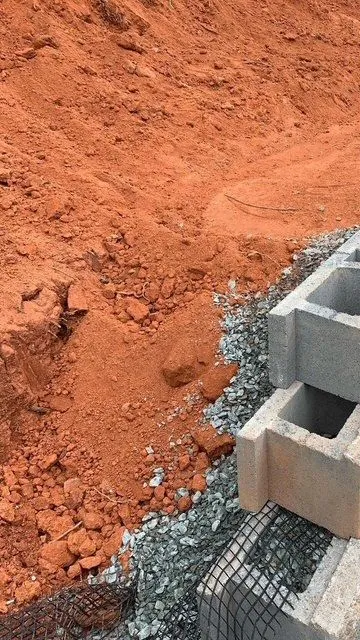
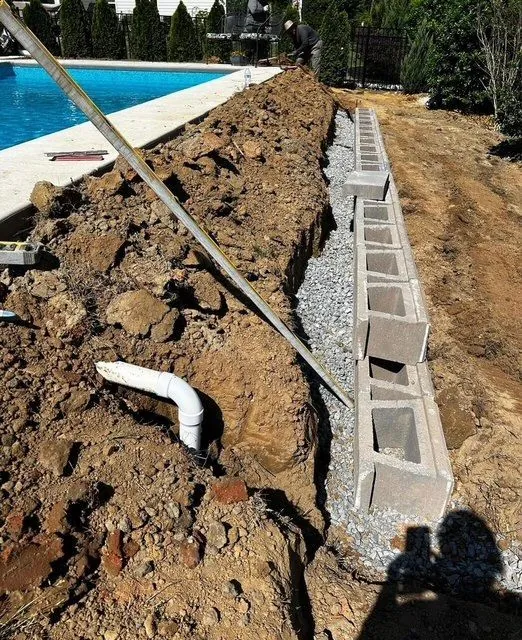
Clean stone, filter fabric, and a pipe that reaches daylight go behind every wall that holds soil, garden walls included. It is a small share of the cost and decides most of the wall's life.
Measure the way the city measures
Roswell counts height from the bottom of the foundation to the top of the wall, and walls over 4 feet need an engineer's design under the city's permit checklist. We measure that way at the estimate, so the engineer and the permit are in the price from the start, not a surprise later.
Check the buffers before drawing anything
Roswell's stream buffer guide limits where walls and outlets can go near creeks and the Chattahoochee. We find the line first and design around it.
Those rules shape how we talk at the estimate, too. We explain the base, the stone, the pipe, and the outlet before block colors come up, and we put each one in writing so you can compare our estimate line by line with anyone else's.
What is Roswell ground like to build on?
It is Piedmont ground. The New Georgia Encyclopedia explains that the red in the clay comes from iron oxides left as rock weathers, and that clearing and farming stripped a foot or more of topsoil from Piedmont uplands. The National Park Service notes that the Chattahoochee follows the Brevard Fault Zone, the boundary between the Appalachian Mountains and the Piedmont.
The town itself grew from that water. Explore Georgia recounts that Roswell King built a cotton mill on Vickery Creek in the 1830s. The same slopes and creeks that powered those mills are why so many Roswell yards need walls today.
How is the company run?
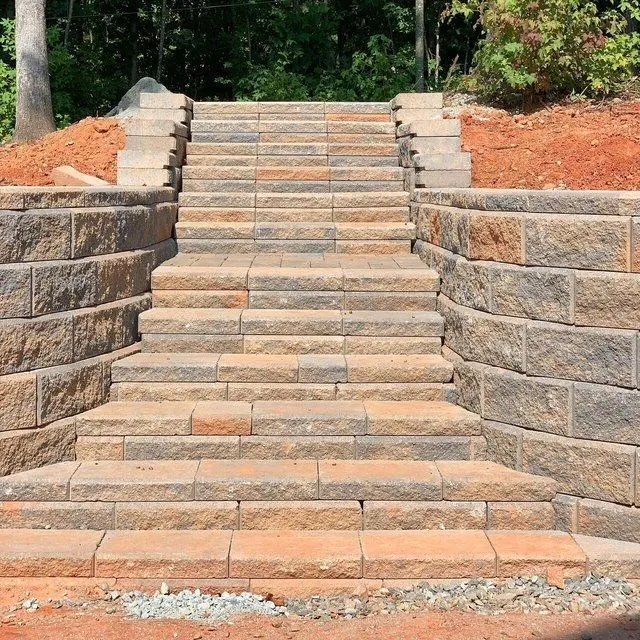
We are locally owned and owner-run, with our office at 875 Atlanta St in Roswell (visits by appointment only). The person who walks your slope at the free estimate is responsible for the wall that gets built. We keep crews small enough that the owner is on site, and we only build retaining walls, steps, and the drainage that goes with them, so the details never become an afterthought.
Our phone line is open 24/7, and estimates are free. Sometimes the honest answer at an estimate is that your wall can wait, or that a downspout extension will do more good than new block. We would rather say so.
What do we stand for?
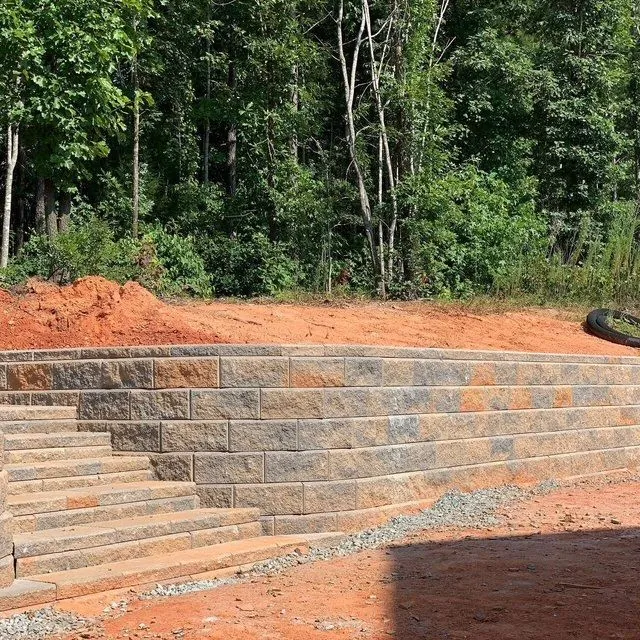
- Build it once. A wall should outlast the people who paid for it, so we do the buried work as carefully as the face.
- Say it plainly. Repair or rebuild, engineer or not, permit or not: you hear the answer and the reason at the estimate.
- Leave the yard better. Water routed away, debris hauled off, and the outlet shown to you so it stays clear.
Want to read more first? Start with the repair page, the Roswell permit guide, or our projects.