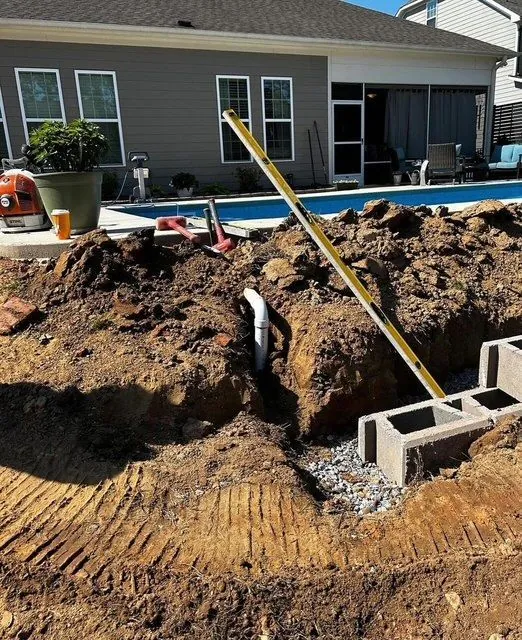
Why does drainage matter so much behind a Roswell retaining wall?
Because wet clay is heavy and Roswell is built on clay. When rain soaks the soil behind a wall and the water has no way out, the pressure on the wall climbs with every storm. Drainage stone, filter fabric, and a pipe to daylight let that water leave, so the wall only holds soil, not soil plus water.
Most failed walls we look at have the same story: clay backfill, no stone, no pipe or a pipe with no outlet. Drainage costs a small share of a wall and decides most of how long it lasts.
What belongs behind a retaining wall?
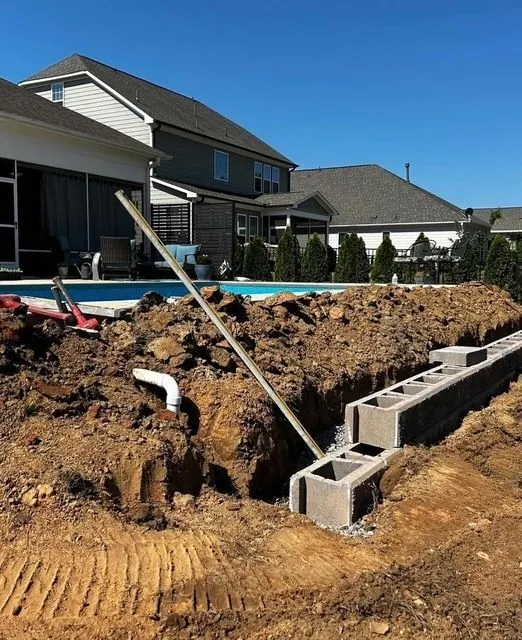
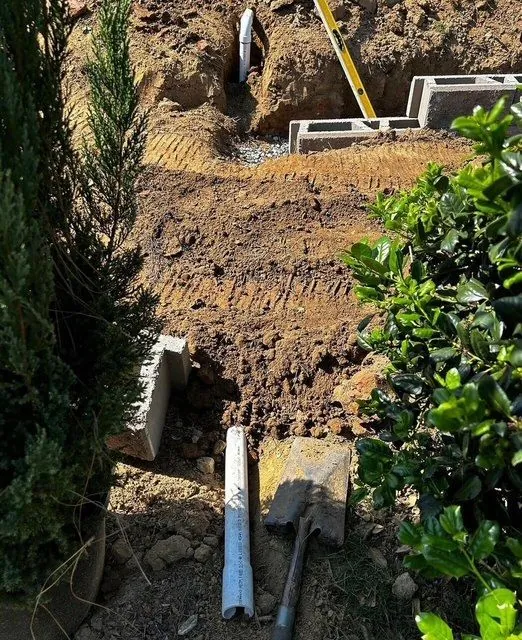
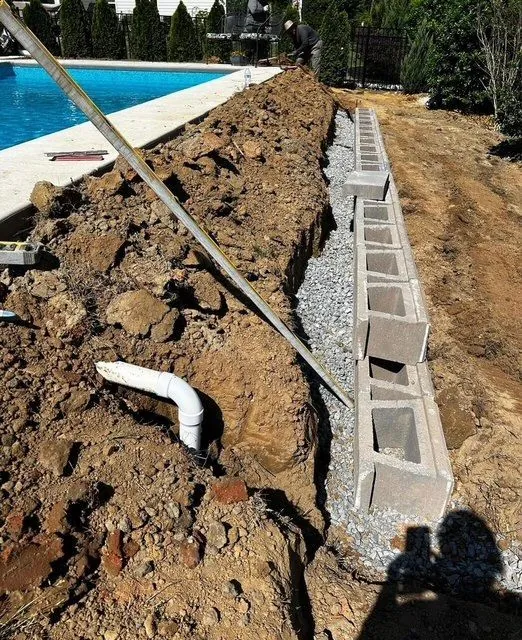
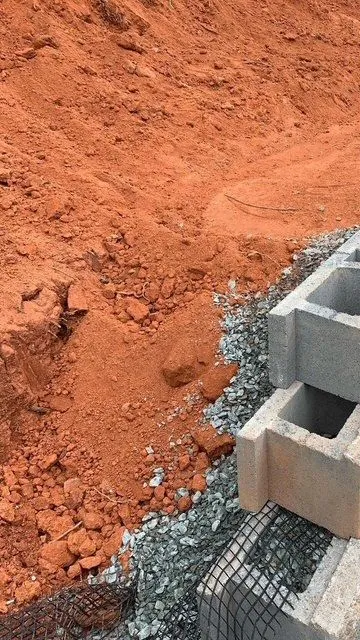
Clean crushed stone, with no fines, directly behind the block and in the hollow cores. Water drops through it to the base instead of pressing on the wall.
Filter fabric between the stone and the native clay. Without it, fine clay migrates into the stone and clogs it over a few years.
A perforated pipe at the base of the stone, running to a daylight outlet with steady fall. On long walls we add outlets along the way.
A sloped grade at the top that sends surface water away from the wall, and caps glued tight. Less water in means less water to remove.
Why is Roswell clay hard on walls?
Roswell sits in the Piedmont. The New Georgia Encyclopedia describes the red clay there as weathered rock, colored by iron oxides, and calls that mixture saprolite. It also records that clearing and farming eroded the Piedmont uplands heavily, stripping a foot or more of topsoil over decades. Much of what sits behind a wall here is dense subsoil.
Dense clay drains slowly. After a wet spell it stays saturated for days, which is exactly when a wall without drainage is under the most pressure. Backfilling a wall with that same clay is the most common mistake we see.
How do we handle water before it reaches the wall?
The cheapest water to remove is water that never gets behind the wall.
- Downspouts. Roof water piped past the wall to a safe outlet, not dumped at the top of the slope.
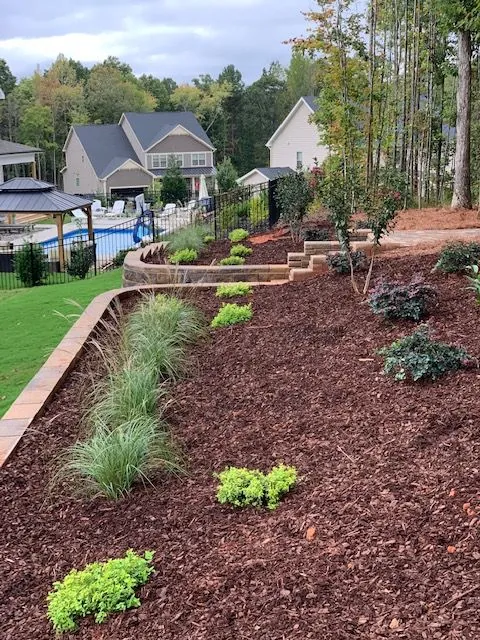
- Swales. A shallow, grassed channel above the wall that carries runoff around the ends.
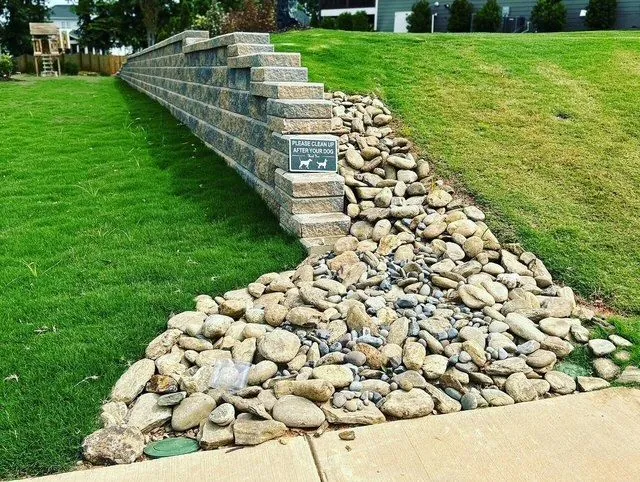
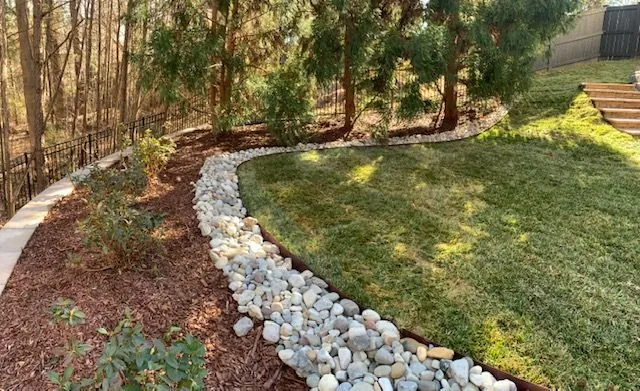
- Dry creek beds. River rock channels that move water through a yard and look good doing it.
- Yard drains. A trench with stone, fabric, and pipe to intercept water across a slope above the wall.
Where is water allowed to go on a Roswell lot?
Water has to leave your wall without causing trouble next door or in a stream. Roswell's guide to trees and streams explains that every stream carries at least the state's 25-foot undisturbed buffer, and the city sets wider buffers on many streams: 50 feet plus a 25-foot setback on flowing streams, and 100 feet plus a 50-foot impervious setback on perennial streams shown on the city map.
Along the Chattahoochee, the same guide describes a corridor running 2,000 feet from each bank, with clearing barred within 50 feet of the river and within 35 feet of tributary creeks. We plan outlets so they discharge onto stable ground on your property, and we check the buffers before we route a pipe. Neighboring jurisdictions draw these lines differently: Johns Creek buffers ponds and lakes as well as creeks, and East Cobb follows Cobb County's map-based widths. Details are on the permit page.
The flowing and perennial stream widths above come from an older city guide. Current rules we could confirm: the 25-foot state buffer (Georgia EPD), the river corridor buffers in UDC Sec. 8.1.3, and a land disturbance permit for work within 200 feet of a stream buffer (UDC Sec. 13.8, per the city's Code Enforcement Guide).
How can you tell whether a wall has drainage behind it?
Start at the low end of the wall and follow the ground downhill. A wall with a drain pipe usually has an outlet somewhere: a pipe end in the lawn, a pop-up emitter, or a tie-in at a swale. If you cannot find one anywhere, the pipe may be buried, crushed, or missing altogether.
- Wet bottom courses. A face that stays dark and damp along the base for days after rain says water is sitting behind it.
- White staining. Chalky deposits on block are salts left behind as water works through the wall instead of around it.
- Red clay in the joints. Soil showing between blocks means the wall was backfilled with clay, or the fabric has torn.
None of these on its own means a wall is failing. Together they mean water is doing work it should not, and it is worth a look before the wall starts to move. At the free estimate we can open a small area behind the cap to see what is really back there.
What are the steps in a drainage fix?
Watch the water
We look at where water collects, where it runs, and where the wall is wet or leaking.
Pick the fix
Stone and pipe behind the wall, a yard drain above it, a swale, or a rebuild where the wall is already moving.
Locate and dig
After the 811 locate, we open the trench or the back of the wall.
Stone, fabric, pipe
Fabric against the clay, clean stone, and pipe with steady fall to a daylight outlet.
Grade and show you
We regrade so water runs away, and show you where the outlet is so it stays clear.