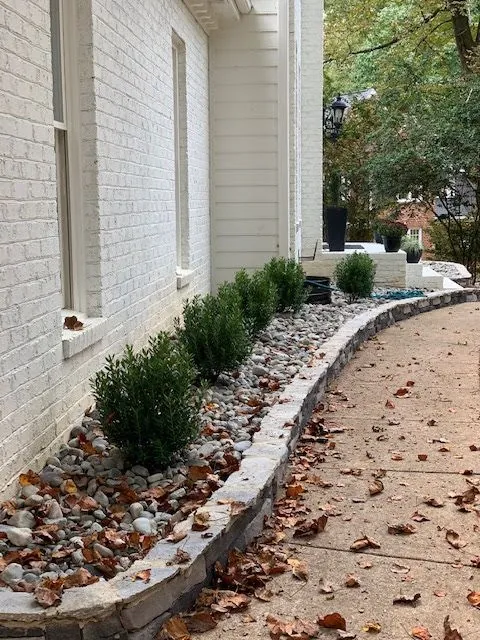
What will a retaining wall in Milton have to look like?
If it faces a street, it will probably wear stone, brick, stucco or wood. Milton's Unified Development Code (adopted April 8, 2024) says block walls visible from a public street must be faced in one of those materials outside agricultural districts, and street-side walls stay at or under 5 feet and at least 3 feet off the right-of-way.
That is a different starting point from most cities around here, where the rules are mostly about height and engineering. Milton cares about how a wall looks from the road, which fits a city described by its rural and equestrian heritage and spacious residential lots. In practice it means we often price a Milton wall as a block structure with a natural stone face, or as a natural stone wall outright, rather than bare segmental block.
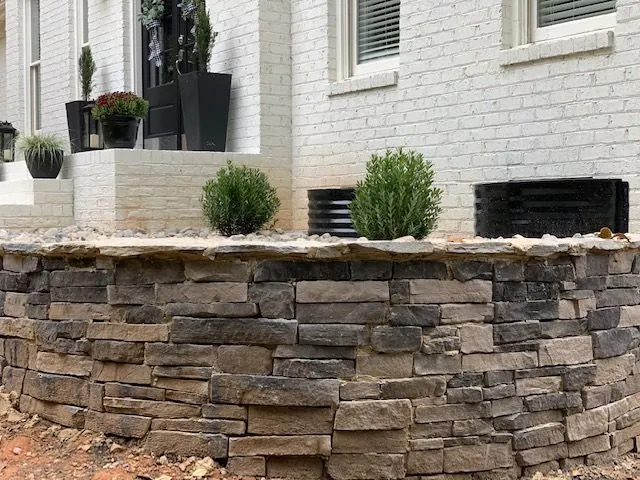
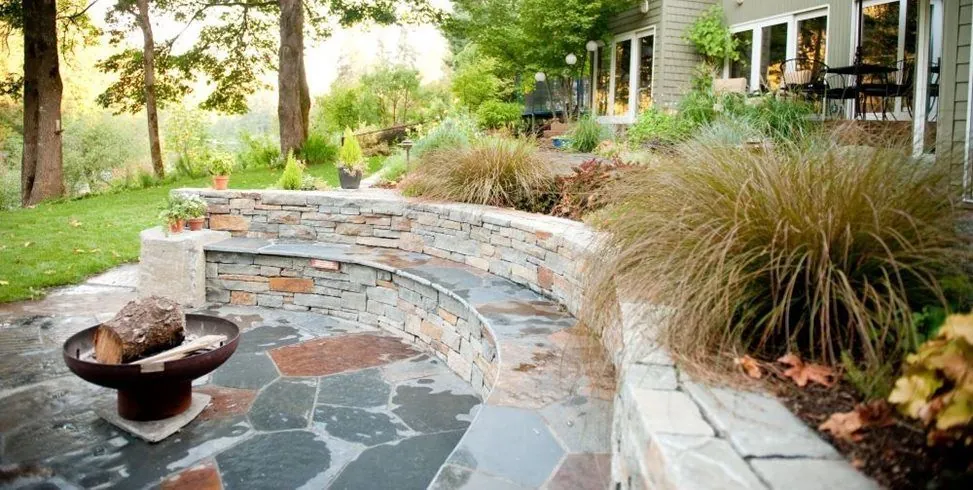
Which parts of Milton's code touch a retaining wall?
Three: the fences and walls rules for anything near a street, the UDC's dedicated retaining wall section, and the land development and stream buffer rules for the ground the job disturbs.
City of Milton: walls and site work
| Retaining walls | Must conform to the UDC's retaining wall section (Sec. 9.3.7), cited from Sec. 2.3.2 |
|---|---|
| Street-side walls | Not over 5 feet from finished grade along exterior streets; at least 3 feet from a public right-of-way; must not block minimum sight distance |
| Facing | Common aggregate block visible from a public street faced in stucco, stone, brick or wood (except agricultural districts); Director approves treatment of poured concrete and block walls |
| Form-based areas | Crabapple and Deerfield: the 42-inch first-layer limit on fences and walls excludes retaining walls |
| Land Development Permit | Over 1 acre disturbed, within 200 feet of state waters, or more than 5,000 sq ft of new impervious surface |
| Contact | Community Development, permits@miltonga.gov; city main line 678-242-2545 |
Source: Milton UDC, Land Development and Community Development, City of Milton
We could not open the text of Sec. 9.3.7 itself for this page, so we do not quote its height or engineering numbers here. We read it for your parcel before we price a wall.
Will your Milton wall need a Land Development Permit?
Only if the job crosses one of the city's lines: more than an acre disturbed, any work within 200 feet of state waters, or more than 5,000 square feet of new hard surface.
The acre and the hard surface numbers rarely come into play on a single wall. The 200-foot line is the one that matters on a Milton lot with a creek, pond or spring anywhere near the work, and it is a long reach. Try your own numbers.
Tool: Milton permit triggersLand development
Fill in the three numbers.
Thresholds come from the city's Land Development page and the UDC's fences and walls rules. Other situations can need a permit too, so we confirm with staff.
Even when none of these trips, the building side still applies, and the city says residential permit applications get approval or revision comments within 10 business days of acceptance, per its residential building page.
Why do Milton walls tend to run long?
Because the lots are big and the ground moves. Milton covers about 39 square miles with elevations from roughly 950 to 1,280 feet, so a wall that levels a riding ring, a pasture edge or a long driveway can stretch farther than a typical subdivision wall.
Length changes the job in ways height does not. A long wall crosses more changes in grade, so it steps down along its run, and each step is a place where the base has to be right. It also collects more water, so the drain pipe and outlets need planning along the whole length, not only at one end. And on open ground, equipment access is easy but the delivery of stone or block to a far corner of the property needs a route that does not rut a pasture or a lawn.
On a long wall we walk the full line at the free estimate, mark where it steps, and show where the water will leave. If a property has a gravel or dirt drive that washes out where it cuts into a slope, a low wall with a proper outlet is often the fix. Walls with steps come up too, where a path climbs from a barn or a lower field to the house.
How do Milton's stream buffers shape where a wall goes?
They set an undisturbed strip along the water and a further setback behind it. In the version of the city's stream buffer article posted with a council agenda, that is 50 feet undisturbed plus another 25 feet, measured from the point of wrested vegetation, doubled in protected small water supply watersheds.
The article exempts existing landscaping, gardening and lawn maintenance, but new land disturbance on those properties is subject to the buffer. Building a retaining wall is new disturbance. So the wall goes outside the buffer and setback, and anything inside them stays planted. Variances exist, but the article reserves them for specific physical conditions or extreme hardship, requires a public hearing, and asks for an alternative plan without the intrusion. Most of the time, moving the wall upslope is faster and cheaper than a hearing.
That ordinance text appeared with a council agenda item and contains some internal differences between sections. We treat it as a guide and confirm the current buffer widths with Milton Community Development for each lot.
Is Milton within reach of our Roswell crew?
Yes. Milton is bounded on the south by Roswell and Alpharetta, so our Roswell office at 875 Atlanta St is just below it.
Milton runs up to Cherokee County on the north and west and Forsyth County on the east. Our service area stops at the Milton line; for work in those counties, call and we will tell you honestly whether we can take it.
- AlpharettaStacked walls closer than twice the lower height count as one wall
- East CobbCounty permits from 30 inches, with buffers set by the county map
- RoswellOur home city and base